The water forest
Qingshan Lake Water Forest
A close look at the experience itself — tall trees standing in still green water, boardwalks over the shallows, and what there actually is to see, do and pay for.
Last updated · How we keep this current
Short answer
What is the Qingshan Lake Water Forest like to visit?
Quick facts
- Also known as
- “Matcha Lake” (nickname)
- Region
- Lin’an District, Zhejiang
- Getting there
- Metro Line 16 to Qingshan Lake Station, or a driver/tour
- Best season
- Green ≈ June–October; red foliage in Nov (not guaranteed)
- Admission
- Greenway free · forest boardwalk reported ~¥40 (verify)
- Time needed
- 2–4 hours
Free park or paid forest? (the bit everyone gets wrong)
This trips up almost every guide, so it’s worth clearing up first. “Qingshan Lake” is a large scenic area with a long, free lakeside greenway — lawns, cycling, open water. The viral matcha-green scenes are in a smaller, separate part: the water-forest boardwalk, which has its own ticket. If you only walk the free greenway expecting the famous green corridor, you may miss it entirely.
| Lakeside greenway | Water-forest boardwalk | |
|---|---|---|
| What it is | The long path around Qingshan Lake — lawns, cycling, open water | The grove of trees in green water, on raised boardwalks |
| The matcha-green scenes | Mostly around the edges | This is where the famous views are |
| Cost | Generally free | Separate ticket — reported ~¥40 (students often half price) |
| Best for | A relaxed walk or cycle | The photos you came for |
Prices, hours and access change — confirm the current ticket and opening times before you go.
What you’re actually looking at
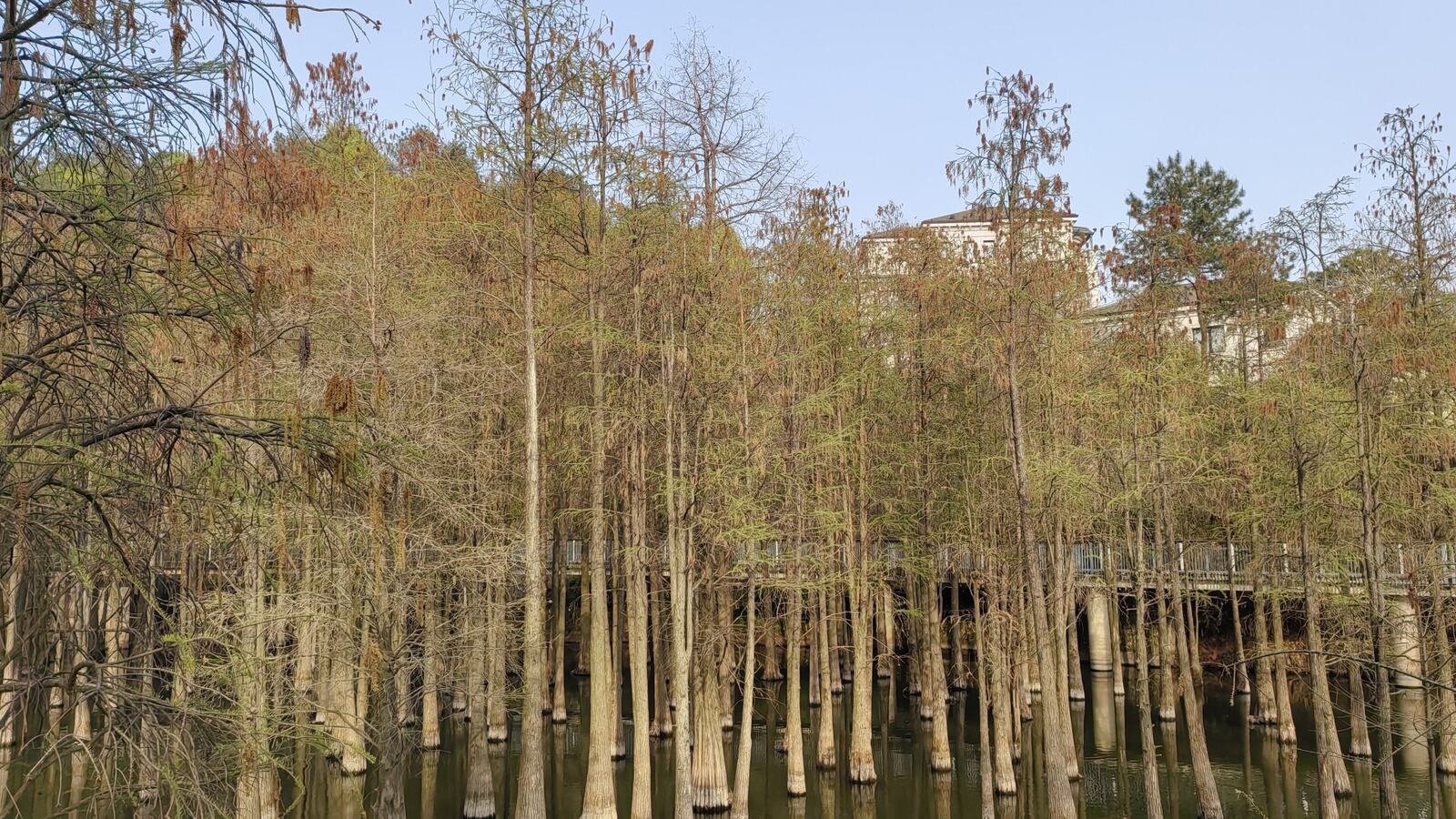
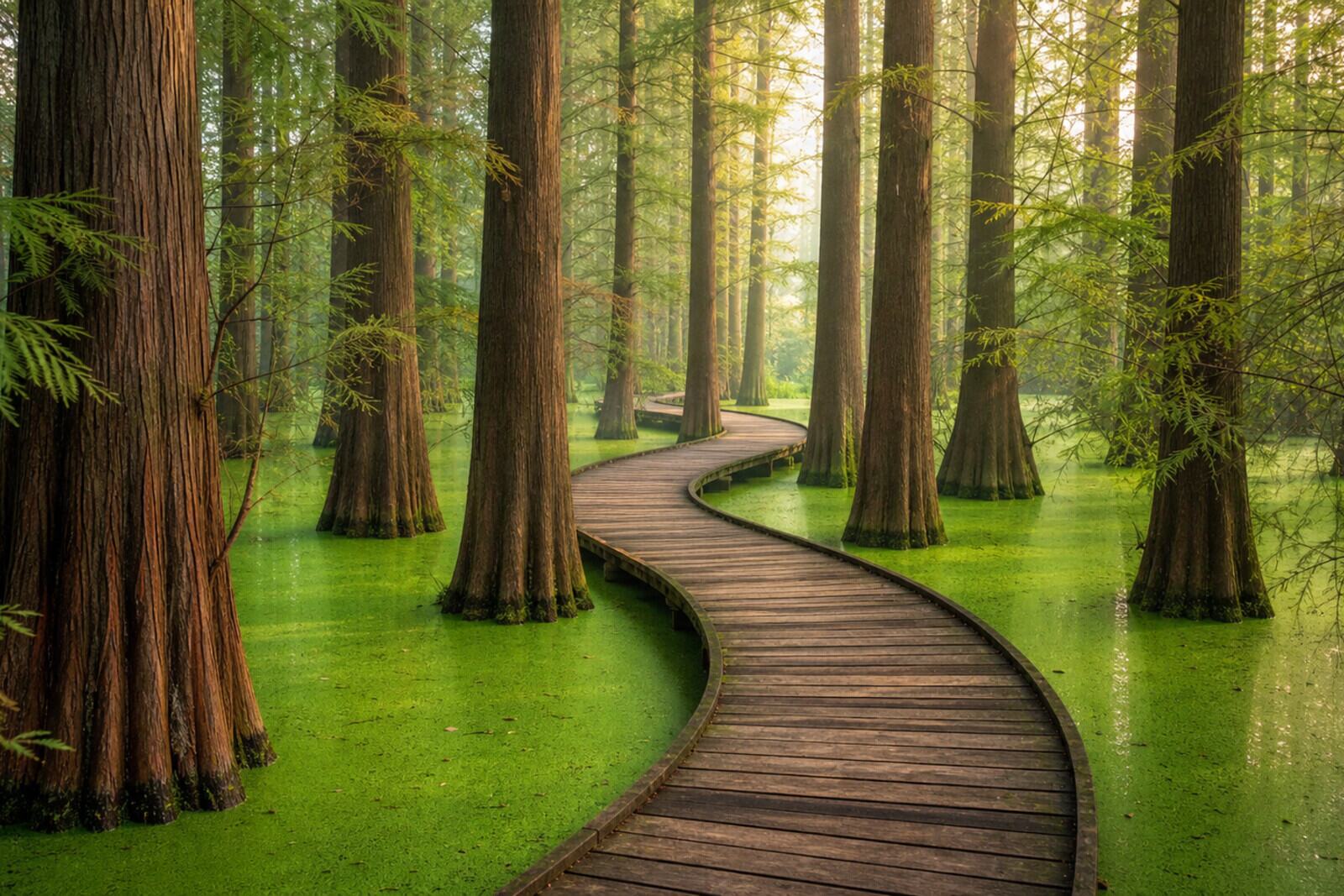
The water forest is a stand of bald cypress and dawn redwood growing in water that sits only shallowly around the trunks. The trees are tall and closely spaced, so from the right angle you get long, mirror-still reflections and a corridor of vertical lines marching back into the grove. When the water is calm, the reflection doubles the height of the forest and produces the images that made the place famous.
It is a compact spectacle rather than a sprawling one. Set expectations accordingly: this is one striking scene to walk through and photograph, not a full day of attractions. That is exactly why we suggest pairing it with other west-side Hangzhou stops if you are travelling out this far.
Why the water turns green
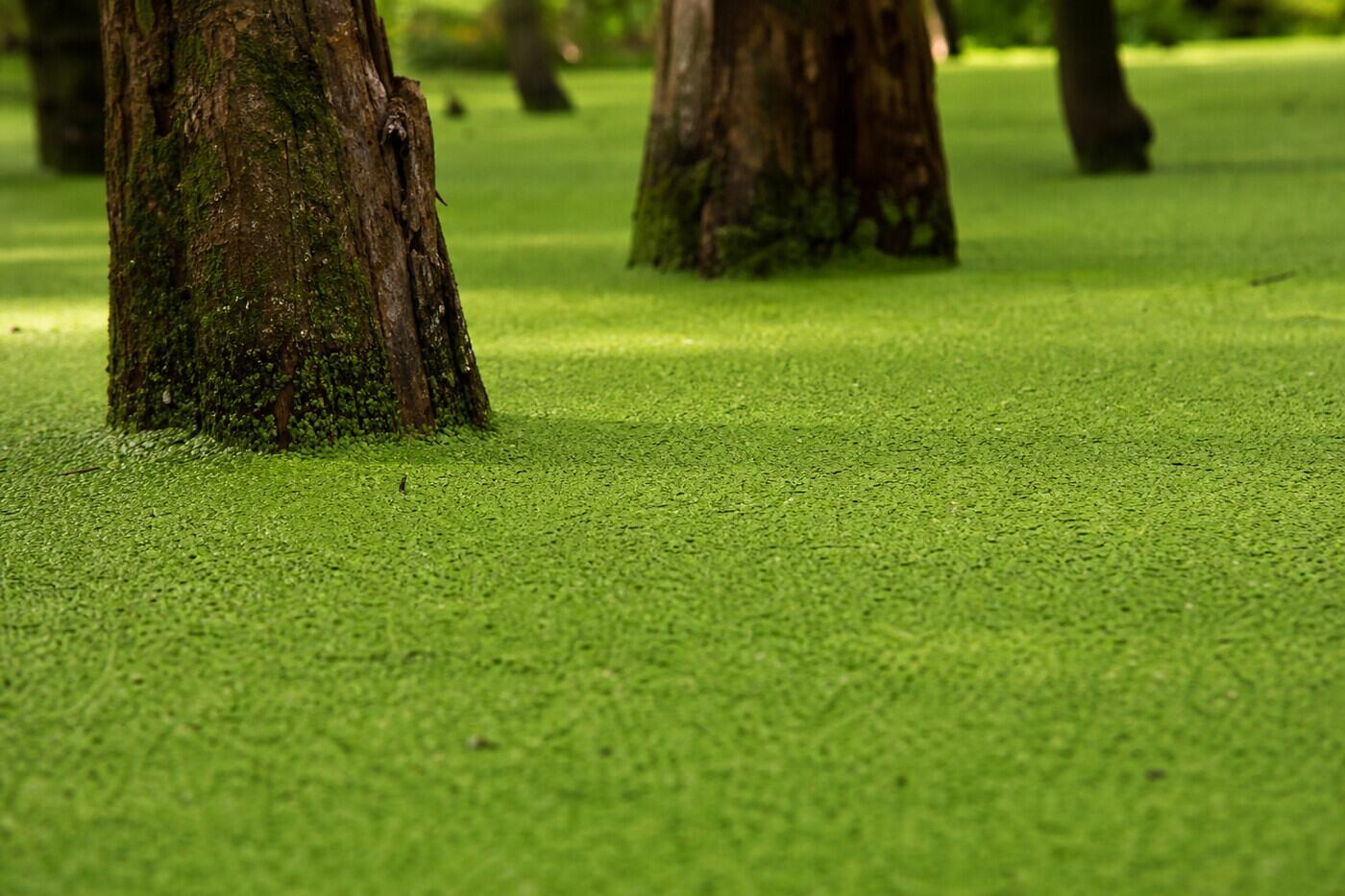
The colour is biological, not a filter, and it is not dyed — a question a lot of first-time visitors ask. In warm weather, tiny floating water plants and algae multiply across the shallow, slow-moving surface and knit into a continuous green carpet. Up close it reads as a fine, powdery layer sitting on the water; from a distance it becomes the flat, opaque tea-green everyone photographs. When temperatures drop and the plants die back, the effect fades and the water can look clear, brown or simply ordinary.
Two honest caveats follow. First, the green is a warm-season phenomenon — broadly June through October — and it shifts year to year with temperature and rainfall, so no one can promise it for a specific date. Second, what makes it beautiful in a photo is a natural bloom, which can look thicker or patchier in person than the most viral images suggest.
Boardwalks, boats and what it costs
The main way to experience the forest is on foot. Boardwalks and paths let you walk out over and alongside the water, weaving between the trunks so you see the reflections from several angles rather than one fixed viewpoint. It is gentle, mostly flat walking, and the whole circuit is short — the appeal is looking and photographing, not covering distance.
People often ask about getting onto the water by kayak or boat. There usually are options in the warm season, and a kayak is the closest way to the green — but whether they run, and at what price, depends on the operator, the day and the season, so treat them as a nice-if-available bonus and confirm on site.
| Activity | What to know | Reported price |
|---|---|---|
| Boardwalk walk | The core experience; gentle and mostly flat | Included with the ~¥40 ticket |
| Kayak | Closest way to the green water; seasonal / operator-dependent | ~¥120/hr single · ~¥220 double |
| Boat tour | A shorter, guided way onto the water | ~¥40–80 |
| Cycling the greenway | Free lakeside path; bike hire available | Bikes ~¥20–40/hr |
Reported figures that vary by season and operator — rough guidance only, confirm on site. Whether boats and kayaks run on a given day is not guaranteed.
How long to spend, and when
Allow two to four hours to walk the boardwalks, find the best reflection lines, get onto the water and take your photos. Photographers chasing the cleanest light and calmest water arrive early and linger; a still, soft morning does far more for the scene than harsh midday sun. If the green season and the weather line up, an unhurried early visit is the version of this place worth planning for.
Mistakes to avoid
- Staying near the entrance. The outer edges look ordinary — the viral scenes are deeper inside the forest and out on the water, so keep going.
- Going in the wrong season. Outside roughly June–October the green fades; check very recent photos for your dates.
- Arriving midday on a weekend. Harsh light and crowds flatten it — a calm weekday morning is far better.
- Only walking the free greenway. The famous green corridor is the separate, ticketed water-forest boardwalk.
Worth it if
- You’re drawn to the green water and want the reflection photos.
- You can travel between about June and October, ideally on a calm morning.
- You’re happy to pair a short, scenic stop with other west-side sights.
Maybe skip if
- You’re visiting in the cool months when the green fades.
- You want a full day of varied things to do in one spot.
- You’ve only got one day in Hangzhou and haven’t seen West Lake.